|
|
| |
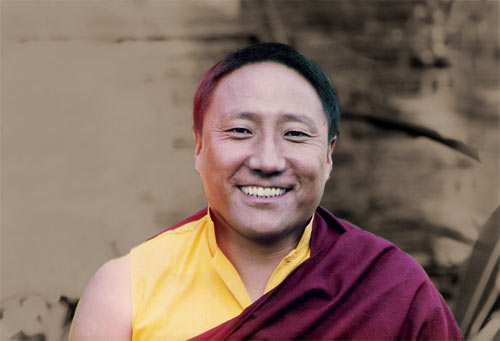
| the Eighth Kyabje Dorzong Rinpoche |
|
| |
Precise details of the birth of the present Dorzong Rinpoche were foretold very clearly by the Seventh Kyabje Drukpa Yongdzin Rinpoche, the root teacher of the Seventh Kyabje Dorzong Rinpoche. These details were also given by the Eighth Kyabje Khamtrul Rinpoche and by a well-known realized master, Kyabje Agon Rinpoche, of the Drikung Lineage, in a remote place in Central Tibet.
At the time of conception of the Eighth Kyabje Dorzong Rinpoche, his
mother dreamt that she was standing in a spacious valley full
of yellow flowers; in the sky to the East there was a long
carpet of white clouds bearing many lamas. Their red hats
were of an unfamiliar design to her. In the center sat a very young,
beautiful-looking lama on his throne. He wore white cotton
robes and a white hat with a high pointed crown. The young
lama was looking at her with an expression of delight.
Immediately she was suffused with
uncontrollable devotion and plucked a large bouquet of yellow
flowers and offered them to the young lama and the other lamas. |
| |
| |
|
 |
 |
| |
|
| the Eighth
Kyabje Dorzong Rinpoche |
Present Kyabje Dorzong Rinpoche In Tibet |
|
| |
 |
| |
Since the night of that dream
she felt the new life within her. Almost three years later,
when she attended her son's enthronement (the present Eighth Kyabje Dorzong Rinpoche),
at Dorzong Monastery, she saw the Drukpa Kagyu meditation
hat for the first time in her life and recognized it from
her dream. And when she described the high-crowned white hat
worn by the central young lama, the senior lamas at Dorzong
Monastery told her that this was Rechunpa’s hat. The
origin of the Dorzong emanations is Vajrapani, Ananda, Palgyi
Dorje, one of the 25 chief disciples of Padmasambhava and
Rechungpa, one of the two main lineage holders of Milarepa’s
teachings.
Kyabje Dorzong Rinpoche was born in early
summer, at sunrise. A fine drizzle fell from a thin cloud
and rainbows appeared over the family home. The people of
Ngeyul village felt certain that the child was a tulku when
seeing these special signs. That same morning a lotus design
appeared on the water’s surface in four of the seven
offering bowls in the family shrine room. The pattern descended
and became indelibly embedded in the base of the bell-metal
bowls. These treasured family possessions were destroyed at
the time of the Cultural Revolution in Tibet.
Also on the same morning a pair of ravens suddenly appeared
and perched on the family’s roof. There they stayed until
the day the infant Kyabje Dorzong Rinpoche was taken to his monastery.
It was later discovered that these were the same ravens, that
normally lived on the roof of the protectors’ gonkhang
at Dorzong Monastery, in Gon Jo, but had disappeared at the
time of Dorzong Rinpoche's birth. This monastery was founded during the reign of the Fourth Kyabje Dorzong Rinpoche, when the people of Gon Jo had asked that another monastery be established in their area. This new monastery was a two-day horse ride from Ngeyul.
The Eighth Kyabje Dorzong Rinpoche was enthroned at the age of three.
From five years old he began to study. In reading, writing and memorizing he showed exceptional aptitude.
When he was seven,
he visited Khampagar Monastery to meet the Eighth Kyabje Khamtrul
Rinpoche. At his time the “Great Practice of Padmasambhava
Sadhana” was being performed at the Khampagar Monastery.
This sadhana is held every 12 years and takes almost one month
to complete. The young Kyabje Dorzong Rinpoche joined in the practice
and completed the ritual entirely from memory. A large assembly
witnessed this feat and the feeling was that this young Rinpoche
was exceptional.
| |
|
 |
| |
|
| the Eighth
Kyabje Dorzong Rinpoche - 1987 - |
From that year Kyabje Dorzong Rinpoche
began to receive Drukpa Kagyu initiations, teachings and
higher practices from Kyabje Khamtrul Rinpoche. At the age of
eight, Kyabje Dorzong Rinpoche received teachings of all traditions,
especially on Mahamudra and Mahasandhi from Kyabje
Ragtul Rinpoche, a Nyingmapa lama who was highly respected
by masters of all schools. Also from this age, he started
to learn basic Buddhist doctrines and texts on the three types
of vows. He studied texts written by Shantideva and other
Bodhisattvas and the three main philosophy texts of Madhyamika
with Venerable Tulku Tashi Namgyal and Venerable Drayab Khenpo Lodru,
one of the most famous Sakya Khenpos of that period in Kham.
When he was nine, he received
special Mahamudra and Dzogchen meditation practice and was
guided through these experiences by the Kyabje Ragtul
Rinpoche (one of the most respected non-sectarian masters
of that period) and was also given the full set of Kagyu
tantric treasures teachings (Kagyu Ngag Dzod), as well as
all the Namchoe terma transmissions. Additionally, he received
three main Nyingma practices of the tutelary deities of Padmasambhava,
which were discovered in the eleventh century and also the full teaching of
Tsele Natsog Rangdol. At this time he received all the ancient
100.000 tantric teachings of the Nyingma Lineage transmission
(Nyingma rgyud ’bum) from Venerable Rongmi Lama Gedun.
At the age of fourteen he entered Khampagar Monastery’s
Institute for Higher Studies and studied under the great Khenpo
Pema Tharchin from Kathog, the ancient Nyingma Monastery.
Under this eminent Khenpo he learned the Madhyamika and the
two main Abhidharma Kosha texts, as well as Buddhist philosophical
texts by Kyabje Mipham Rinpoche. In his examination, he always stood
first in his class.
|
| |
| |
|
 |
 |
| |
|
| the Eighth
Kyabje Dorzong Rinpoche with His Eminence Drugu Choegyal Rinpoche
in Bodhgaya |
Walking near Naranjana River, in Pilgrimage, 1999 |
|
| |
Once Kyabje Dorzong Rinpoche was invited
by the people of Rongmi to visit their area near the original
Dorzong Monastery. In this region there lies a range of jagged
mountains the Yongten Ritra (“Bright Mountain of Good
Attributes”), and many lakes of which it is said that
treasure teachings of Padmasambhava are still hidden there.
The party halted in a meadow where the local nomads brought
them yogurt and milk. The sky was clear and blue. Then, as
they sat doing prayers, two banks of clouds appeared in the
sky above them. Then, one after another, wisps of ribbon-straight
clouds emerged from one cloudbank and floated parallel to
join the other, in all nine perfectly formed strips. The people
gathered there were amazed. After a long period of awed silence,
the nine straight wisps returned in succession to be reabsorbed
in the cloudbank. Then the two cloudbanks merged and there
was a roll of thunder and a shower of rain fell. The nomadic
elders agreed that they had never seen such a phenomenon before.
On hearing the story, one of Kyabje Dorzong Rinpoche’s first
root gurus, Kyabje Ragtul Rinpoche explained that since the
local gods, protecting Padmasambhava’s teachings have
connections with the previous Kyabje Dorzong Rinpoche these clouds
had been a scarf offering from these nine gods of the area
to welcome the young tulku on his first visit there.
In 1958, Kyabje Khamtrul Rinpoche
decided to leave Tibet for India and asked Kyabje Dorzong Rinpoche, then 15, to join him.
Their journey was via Lhasa where they
had an audience with His Holiness the Dalai Lama. Then they
made a pilgrimage to the holy places of Central Tibet before
they finally reached India through Sikkim. From 1959 on they stayed
in Kalimpong where Kyabje Khamtrul Rinpoche established Zandok Palri
temple and with the support of Sikkimese, Bhutanese and local
Tibetan devotees was able to take up again dharma activities, including lama dances.
|
Kyabje Dorzong Rinpoche immediately resumed
his studies of philosophy and the Buddhist sutra and tantra
teachings with Venerable Khenpo Thupchoe and Venerable Khenpo Tsondue
of the Nyingmapa school and with Venerable Sakyapa Khenpo Rinchen.
Until the establishment of Tashi Jong in 1969, Kyabje Dorzong Rinpoche
moved between Kalimpong, Dalhousie and Kangra. In this period
he received initiations, Mahamudra teachings and instructions
from The Eighth Kyabje Khamtrul Rinpoche. He also received numerous initiations,
teachings and instructions from His Holiness the Sixteenth Karmapa
and Kyabje Dilgo Khyentse Rinpoche. In 1969 he became Khenpo (abbot of the educational institute for monks)
of the Drukpa Kagyu Institute at Tashi Jong.
Then in 1971, because of Kyabje Khamtrul
Rinpoche´s arduous schedule and health problems, the
people of Tashi Jong requested Kyabje Dorzong Rinpoche to become
Vice-President of Khampagar Monastery and of the Tashi Jong
Community. When Kyabje Khamtrul Rinpoche passed away in 1980
he was asked to stand as President. |
| |
| |
|
 |
 |
| |
|
| His Holiness the fourteenth Dalai Lama
and the Eighth Kyabje Dorzong Rinpoche |
Gathering in Lhasa for
teachings |
|
| |
In that position he performed
all the consultations and arrangements for the recognition
of the reincarnation of the present Ninth Kyabje Khamtrul Rinpoche
in conjunction with His Holiness the Sixteenth Karmapa and Kyabje Dilgo
Khyentse Rinpoche. The enthronement was performed in 1983.
Both as Regent of The Eighth Kyabje Khamtrul Rinpoche and President of
Khampagar Monastery in India and of Tashi Jong Tibetan Community,
Kyabje Dorzong Rinpoche worked twenty-one years with selfless compassion,
wisdom and great energy for the betterment of the monastery
and lay people community. Along with the consolidation of
the craft art center and cultured activities, he introduced
a proper health center, kindergarten and an Institute for
Higher Studies. Later in the 1990's, he received a complete series of initiations of the Drukpa Lineage from the late Kyabje Trulshik Adeu Rinpoche.
In combination with all these activities
Kyabje Dorzong Rinpoche always practised meditation
and lineage teachings with unbroken diligence and purity,
which qualify him as an authentic Drukpa
Kagyu lineage holding Master.
By 1984 it become possible for
Kyabje Dorzong Rinpoche to return to Tibet and visit his monastery.
There he was invited to give teachings throughout the region
at monasteries of all schools of Tibetan Buddhism and he greatly
helped practitioners by giving initiations and teachings,
which provided the missing links in their practice.
He also traveled to many countries
giving lectures and teachings, from which some remarkable
communities and dharma practitioners started.
Besides practising teachings of
the Drukpa lineage, Rinpoche has also practised many teachings
of other Tibetan Buddhism lineages. The Eighth Kyabje Dorzong Rinpoche is one of the most learned, practised and highly
recognized Lamas among the Tibetan Buddhist teachers living
today. He is one of the most respected Drukpa Kagyu lineage
holders Rinpoche for his realization both at home and in exile.
| |
|
 |
| |
|
the Eighth
Kyabje Dorzong Rinpoche with His Eminence Drugu Choegyal gyamtso Rinpoche
and his eminence drubwang tsoknyi rinpoche
- 2008 - |
|
|
PHOTO ALBUM
|
 |
| In Tibet |
 |
| In Pilgrimage |
 |
| Main Temple |
 |
| Stupas |
 |
| Standing Buddha |
 |
| Jangchub Jong |
|
|
